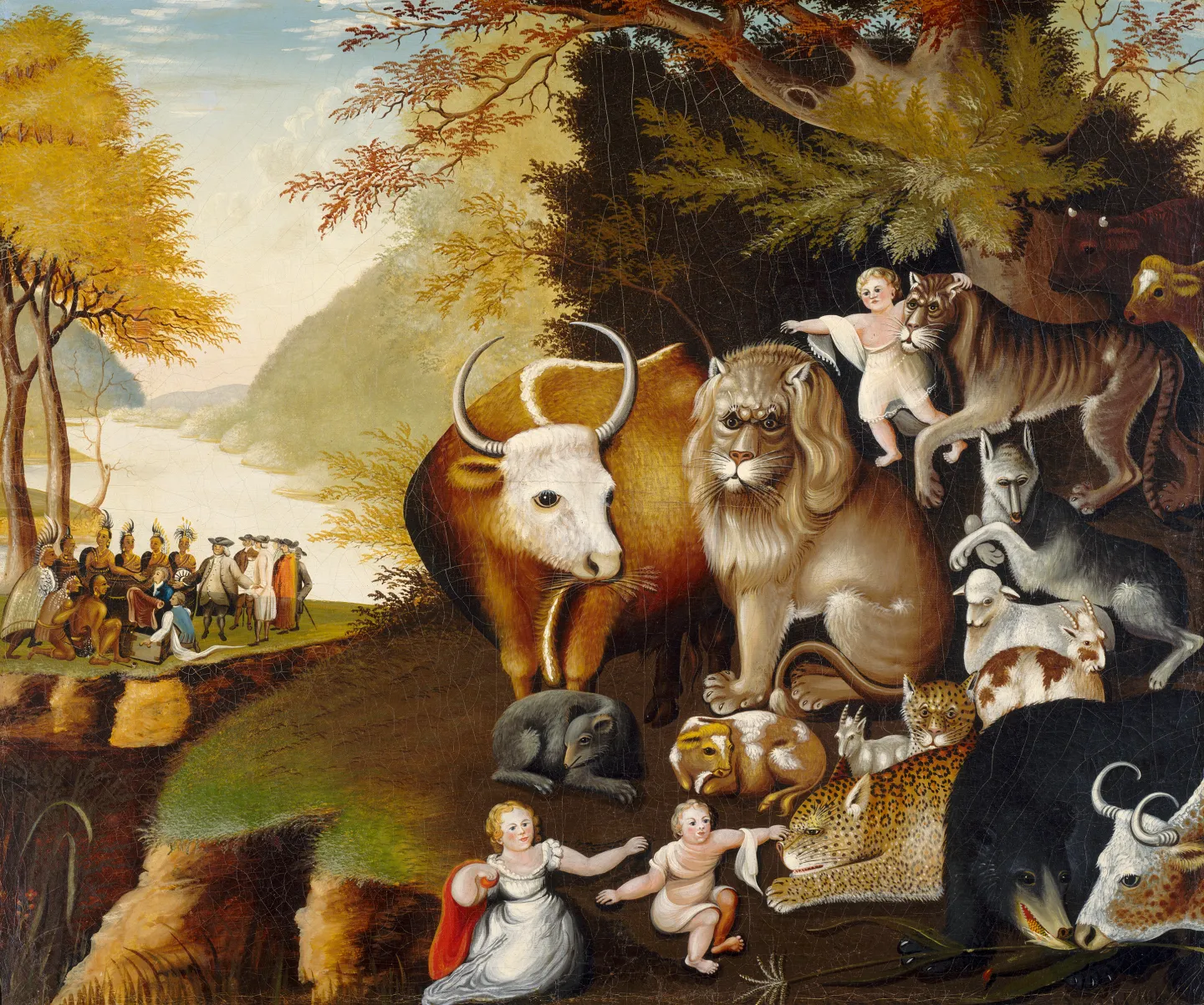
Image credit: Edward Hicks, The Peaceable Kingdom (c. 1833–1834). Public domain, sourced via Wikimedia Commons.
CONTENTS
Curator’s Reflection & Artwork Credits
As we close the first volume of the Nourishing Creation Journal, we invite you to pause and reflect on the visual journey that accompanied our exploration of plant-based nutrition.
In curation, as in nutrition, choices must be deliberate. To ground our modern, evidence-led data in a sense of timeless human heritage, we selected historical, public-domain artworks to introduce each section. These pieces remind us that our connection to the soil, the harvest, and mindful dining is not a fleeting trend, but a foundational human rhythm.
The Art of the Harvest
From the collaborative community efforts captured in Camille Pissarro’s impressionist landscapes to the quiet, respectful endurance depicted in Jean-François Millet’s The Gleaners, these classical paintings celebrate the humble origins of our food. They elevate raw ingredients—a single head of green cabbage, a handful of gathered peas, or an ancient grain—into objects of profound beauty and worth.
Millet’s canvas in particular honours gleaning, one of Europe’s oldest forms of community welfare. Rooted in ancient biblical covenants—such as the agricultural mandates in Leviticus—landowners were commanded never to strip their fields completely bare during a harvest. Instead, the edges and dropped grains were intentionally left behind. This sacred covenant granted the landless poor, the traveller, and foraging animals legal access to the earth’s residual bounty to ensure no living thing went hungry.
The Fabaceae family—our humble peas, beans, and lentils—is a beautiful testament to plant-based nourishment. On an ecological level, these plants are literal “earth-healers”. Working symbiotically with underground Rhizobia bacteria, they draw nitrogen from the atmosphere to enrich and restore exhausted soil from the inside out. When we look at Pissarro’s canvas, we are not just seeing a crop: we are witnessing an ancient partnership that heals the earth while nourishing our bodies.
A Vision of Dynamic Coexistence
To bring this volume to a meaningful close, our final post centres upon Edward Hicks’ legendary folk masterpiece, The Peaceable Kingdom. Inspired deeply by the biblical prophecy in Isaiah 11: 6–9, this striking canvas presents a profound visual metaphor for absolute holistic harmony. Hicks vividly illustrates the scriptural vision of natural predators and prey—where the lion lies down with the lamb, and leopards, bears, and oxen coexist peacefully guided by young children—while framing this biological peace alongside historical depictions of cross-cultural treaty-making in the background.
Within our journal, this imagery serves as the ultimate aspiration for plant-based nutrition. It challenges us to foster a lifestyle that honours deep biological peace: an ecosystem where humans, animals, and microbes thrive in cooperation rather than exploitation.
A Ritual of Nourishment
Similarly, botanical illustrations like the Ficus hispida invite us to look closer at the intricate architecture of plant life, appreciating the complex systems that generate our vital macro and micronutrients.
Concluding this journey, as brought to life by Hanna Hirsch-Pauli’s sunlit canvas, the ultimate destination of this visual exploration is the table—a space where clean water, whole foods, and community meet to create daily vitality.
By combining the latest nutritional science with centuries-old artistic heritage, we hope Volume 1 has inspired you to view your daily meals not just as fuel, but as an act of nourishing creation.
Volume 1 Image Gallery & Attributions
All historical and botanical artwork featured in this volume resides within the public domain. We gratefully acknowledge Wikimedia Commons and the respective global archives for preserving these treasures.
- 01: Introduction (Feature Image)
- Artwork: The Pea Harvest (1887) by Camille Pissarro.
- Source: Public domain, sourced via Wikimedia Commons.
- 02: The Essential Nutrient Matrix (Feature Image)
- Artwork: The Gardener (Old Peasant with Cabbage) (1899) by Camille Pissarro.
- Source: Public domain, sourced via Wikimedia Commons.
- 03: B12 Spotlight (Feature Image)
- Artwork: The Gleaners (1857) by Jean-François Millet.
- Collection: Musée d’Orsay, Paris. Sourced via Wikimedia Commons.
- 04: Iron & Calcium Spotlight (Feature Image)
- Artwork: Ficus hispida L. (Early 19th Century) by an unknown botanical artist.
- Collection: The Cresswell Collection. Sourced via Wikimedia Commons.
- 05: Menu Ideas (Feature Image)
- Artwork: Breakfast Time (1887) by Hanna Hirsch-Pauli.
- Collection: Nationalmuseum, Stockholm. Sourced via Wikimedia Commons.
- 06: Curator’s Reflection (Feature Image)
- Artwork: The Peaceable Kingdom (c. 1833–1834) by Edward Hicks.
- Collection: National Gallery of Art, Washington, D.C. Sourced via Wikimedia Commons.
Sources & Further Exploration
Nutritional & Botanical Science
- The Vegan Society: Vitamin B12 Nutritional Guidelines & Dietary Supplementation Recommendations.
- British Dietetic Association (BDA): Vegetarian, Vegan and Plant-Based Diet Food Fact Sheet.
- NHS Choices: Vitamins and Minerals: Essential Nutrient Guide.
- Ochoa, Dr Sofia Pineda (MD): “Vitamin B12 Questions Answered,” featured in Forks Over Knives.
- British Nutrition Foundation: Creating a Healthy Diet: Resource for Vegetarians and Vegans.
- Govindji, Azmina (RD): Vegan Savvy: The Expert’s Guide to Nutrition on a Plant-Based Diet (Book & Nutrient Bridge Resource).
- The Lancet: The EAT-Lancet Commission on Global Food Systems and Sustainable Health.
Ecological & Botanical Science
- Royal Botanic Gardens, Kew: Legume Science and the Global Future of Sustainable Plant Protein.
- Food and Agriculture Organisation (FAO): Pulses and Soils: A Dynamic Duo for Soil Enrichment and Regeneration.
- Royal Horticultural Society (RHS): Green Manures: Utilising Legumes for Natural Nitrogen Fixation and Soil Fertility.
Art History & Cultural Context
- Musée d’Orsay, Paris: Collection Archive for Jean-François Millet’s Des glaneuses (The Gleaners), 1857.
- Nationalmuseum, Stockholm: Exhibition Catalogue for Hanna Hirsch-Pauli’s Breakfast Time, 1887.
- The Holy Bible: Leviticus 19.9-10 & 23.22 (The Law of the Corners and Agriculture Covenants).
- The Holy Bible: Isaiah 11.6–9 (The Prophecy of Peaceable Coexistence and Ecological Harmony).
A Gentle Note for Your Journey
Professional Guidance & Care
Nourishing Creation Journal
Because our individual lifestyles, genetics, and health histories are completely unique, it is highly important to speak with a registered dietitian or your healthcare professional before making significant changes to your daily diet. In the UK, The Vegan Society collaborates directly with expert nutritionists from the British Dietetic Association to provide safe, balanced guidance for healthy living. The information presented in this volume is compiled for educational and informational purposes only, and should never be used as a substitute for personalised medical advice or formal professional diagnosis.
< Back | Volume 1 | Home
